
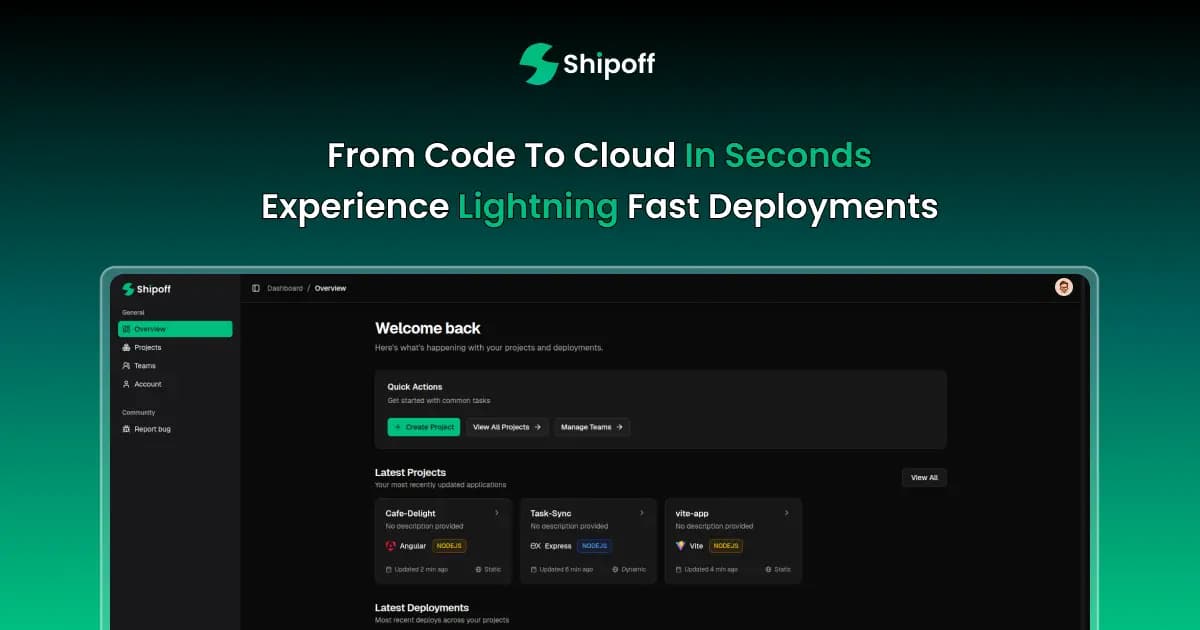
Shipoff – Distributed PaaS Architecture
A technical deep‑dive into Shipoff’s distributed microservices, gRPC, Redis Streams, Kubernetes orchestration, and deployment pipelines.
Technology Stack
Key Challenges
- Synchronizing project and deployment state across multiple microservices without creating distributed race conditions.
- Designing a reliable deployment state machine ensuring deployments are queued to prevent overconsumption of limited compute resources (4 vCPUs, 24GB RAM).
- Coordinating build-service, runtime-service, project-service, and gateway-service using gRPC without inconsistent state transitions.
- Ensuring every microservice has an isolated database while still maintaining global consistency across the platform.
- Choosing a cloud provider that can sustain a distributed PaaS infrastructure on a free tier—Oracle Cloud provided the required compute and networking credits.
- Handling real-time log streaming from Kubernetes pods without overwhelming Redis Streams consumers.
- Managing container build failures, gRPC timeouts, soft crashes, and auto-recovery logic inside Argo CD & k8s.
- Designing a secure routing layer through Cloudflare + Ingress while supporting static + dynamic deployments.
Key Learnings
- Understanding Kubernetes deeply: Deployments, StatefulSets, Ingress routing, autoscalers, readiness/liveness probes, and multi-container orchestration.
- Implementing production-grade gRPC microservices with bidirectional streaming and strict protobuf contract evolution.
- Building resilient distributed state machines with Redis Streams, consumer groups, and backpressure handling.
- Architecting GitOps pipelines with ArgoCD and generating declarative deployment manifests dynamically.
- Implementing secure, multi-protocol build pipelines using Docker Buildx and ephemeral Kubernetes builder pods.
- Mastering cross-service communication, event-driven workflows, eventual consistency, and distributed tracing.
- Learning the caveats of PostgreSQL when used across microservices: schema isolation, migration conflicts, and data contract discipline.
- Handling real-time logs efficiently using Fluent Bit → Redis Streams → WebSocket pipelines.
Shipoff – Distributed Platform-as-a-Service (PaaS)
Shipoff is a distributed Platform-as-a-Service designed using microservices, gRPC communication, Redis Streams event pipelines, and full Kubernetes runtime orchestration. It automates builds, deployments, logs, routing, and project management.
1. High-Level Architecture
Shipoff consists of independently deployable services communicating through:
- gRPC for RPC communication
- Redis Streams for asynchronous event pipelines
- PostgreSQL for service-level DBs
- S3 storage for artifacts
- Kubernetes for runtime orchestration
- ArgoCD for GitOps
- Next.js frontend for developer console
Core Services
- Gateway
- Project Service
- Deployment Orchestrator
- Build Service
- Runtime Service
- Log Service
- Detector Service
- Event Worker
- CDN & Asset Manager
Each service has its own k8s deployment, protobuf contracts, and isolated DB.
2. Deployment Pipeline (Event Driven)
Every deployment runs through a strict, deterministic state machine:
QUEUED → BUILDING → PROVISIONING → PRODUCTION
            ↘ FAILED ↙       ↘ INACTIVE
Stage 1 – Webhook Trigger
GitHub webhook triggers a deployment event → written to streams.deployment.queue.
Stage 2 – Build
The Build Service creates an ephemeral Kubernetes pod to:
- Clone repo
- Install deps
- Build assets / Docker image
- Upload artifacts to storage
Build logs stream through gRPC.
Stage 3 – Provisioning
Runtime Service:
- Creates Kubernetes Deployment
- Applies manifests
- Waits for readiness
- Configures routing
Stage 4 – Production
- CDN invalidation
- Traffic routing
- Old deployments become inactive
3. gRPC Communication
All internal communication uses protobuf schemas.
Example:
service DeploymentService {
  rpc CreateDeployment(CreateDeploymentRequest) returns (CreateDeploymentResponse);
  rpc StreamDeploymentLogs(StreamLogsRequest) returns (stream LogPacket);
}
4. Redis Streams Backbone
Used for async orchestration.
Important streams:
streams.deployment.queue
streams.deployment.progress
streams.logs.ingest
streams.runtime.events
5. Kubernetes Runtime
Each deployment creates:
- Namespace
- Deployment
- Service
- Autoscaler
- ConfigMaps & Secrets
Rollbacks triggered via readiness/liveness probes.
6. Build System
Build pods use Docker Buildx and multi‑stage builds:
- Clone repo
- Install dependencies
- Run build
- Upload artifacts
- Emit events to Redis
7. Traffic Routing Layer
- Cloudflare CDN
- Traefik / NGINX ingress controller
Static → CDN
Dynamic → Container runtime
8. Observability System
- Fluent Bit
- Log Service (gRPC stream)
- Prometheus
- Grafana
Logs flow:
Pod → Fluent Bit → Redis Stream → LogService → WebSocket → Dashboard
9. Frontend Architecture (Next.js)
Using:
- App Router
- TanStack Query
- shadcn/ui
- Server Actions
Conclusion
Shipoff demonstrates expertise in:
- Distributed systems
- Event-driven design
- Kubernetes + GitOps
- gRPC microservices
- DevOps automation
- Real-time streaming